

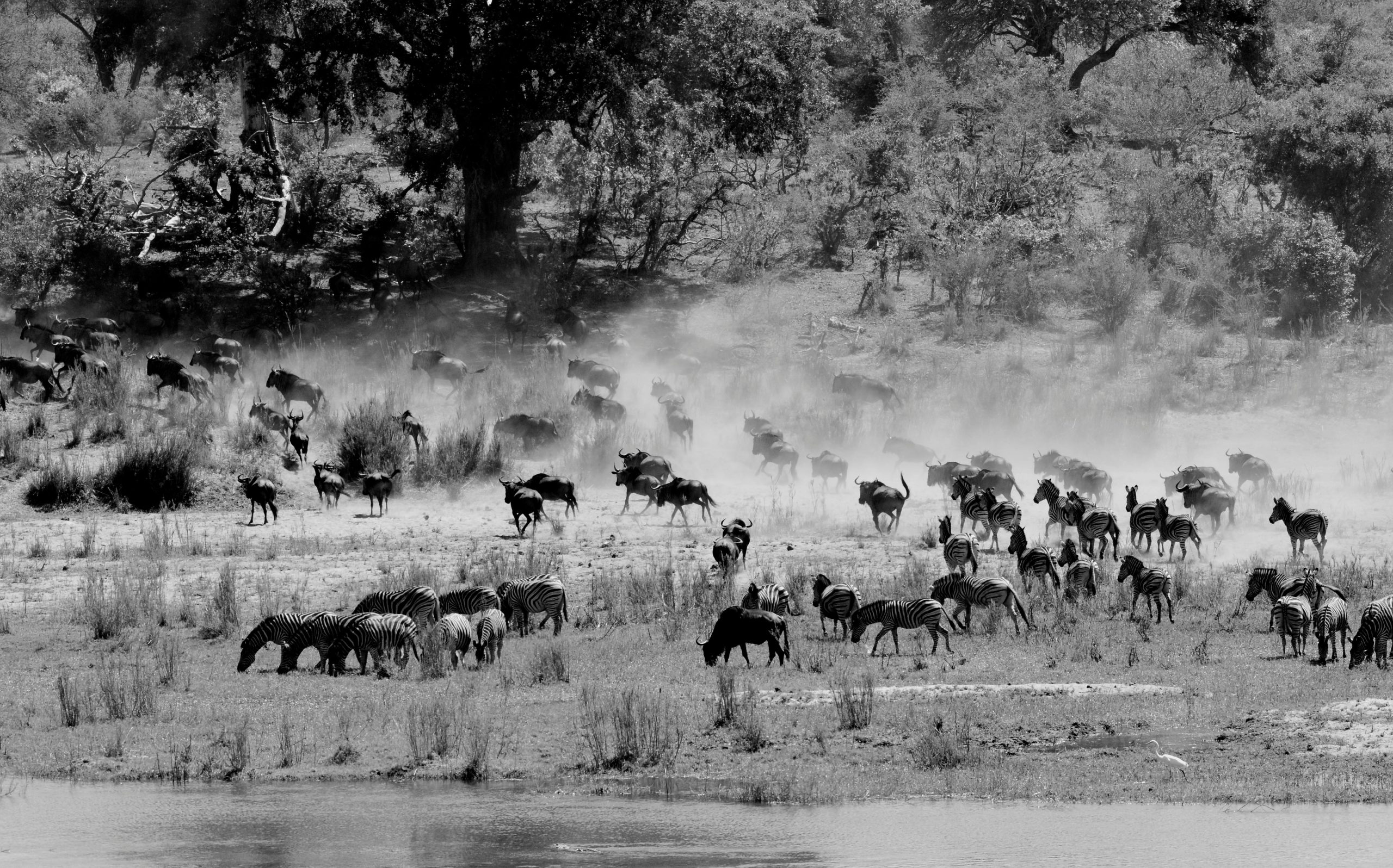
It is astounding that the original estimates of how many individuals are involved in The Great Wildebeest Migration may be over twice as many as the newly emerging figures. Mindblowing, actually.
Take a quick glance at a few leading safari tour operators’ estimates, the numbers fall somewhere between the conservative 1.3 million, average 1.7 million and outlandish 2 million. It seems that these figures have remained largely unchanged since the 1970s, and are commonly cited to paint a picture representing the sheer scale of the great migration.
New figures have set the bar as low as 530,000 wildebeest, and under 600,000 including the other migrating species.
How can this happen?
How are the numbers counted?
Traditionally, the numbers of migrating animals were estimated by an aerial point survey, which involves using a fixed-wing plane to count individuals within the migration over a period of days, and using a mark-recapture technique (called the Jolly Seber method) to estimate the entire population.
The data provided by this technique estimated a population of roughly 250,000 wildebeest in the 1950s, before ballooning to 1.3 million in 1977, after a programme of vaccination against rinderpest. The figure has remained relatively stable since.
To put all that effort under an unhappy cloud, the likelihood of errors using this method is well understood. It seems that recent technology, using a combination of Satellite imagery and AI technology, has unveiled an uncomfortable reality; these numbers could be worryingly incorrect.
As recently as 2022, researchers have been combing satellite imagery and AI to bring a clearer figure into focus.
It needs to be stated that there are still restrictions to stallite imagery, namely its reliance on good weather and inability to count smaller animals, or those under tree coverage. What’s more, the technology cannot yet differentiate between Wildebeest and the other animals, such as Zebra or Eland, migrating alongside; therefore, the figures could even be considered an “overestimation”.
Obstensibly, however, this new technique is delivering significantly more accurate data.
By leveraging satellite images, able to capture an enormous surface area, and object-detecting AI, researchers have found a model that can obtain a better picture of the Great Wildebeest Migration population.

What are the *real* numbers of Wildebeest Migrating in Tanzania?
There were 2 counting models employed; they estimated 502,917 and 533,137 in 2023 – the year prior, in 2022, the same models reported numbers significantly lower, 324,202 (2022) and 337,926.
The most average figure rests around 520,000 wildebeest, and the entire migration, including other migrating species, could be as few as 600,000.
There is an obvious discrepancy within this data too, which further supports the idea that the task at hand is an extremely difficult one.
The question the data is also posing: Is the counting methodology the sole reason for the discrepancy in numbers?
The answer is complex, and there are other factors which could absolutely affect the results: fragmentation of the wildebeest habitat (driven by agricultural and infrastructural development), environmental factors (timing of the rains) and consistent poaching and snarecatching in the Serengeti. Of course, the timing of the study is important too, as there will be far fewer wildebeest before calving season.
It may take a few more years of close analysis- comparing both counting methods – to fully understand the true numbers of Wildebeest taking part in the Great Migration.


 English